

99% Methylene Blue Powder Supplier
What is methylene blue?
Methylene blue is a synthetic phenothiazine compound, soluble in water. It was first synthesized in the late 19th century and initially used as a textile dye. Later, it gradually played an important role in various fields such as medicine, scientific research, and aquaculture.
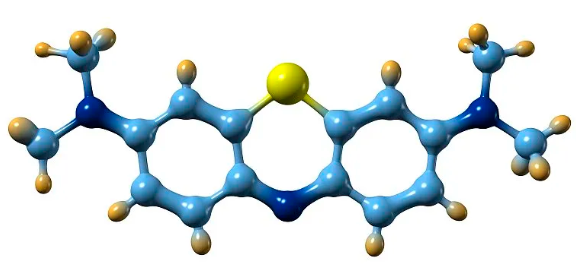
A method for synthesizing pharmaceutical-grade methylene blue, characterized by using p-aminodimethylaniline hydrochloride as a starting material, following the reaction pathway:
Weigh 2 parts of p-aminodimethylaniline hydrochloride (calculated by molar mass ratio) and add it to a reaction vessel equipped with a thermometer. Dissolve it in water, and add 0.41 parts of concentrated sulfuric acid dropwise while stirring. At room temperature, add a solution containing 4.95 parts zinc chloride, 1.00 parts aluminum sulfate, and 2.12 parts sodium thiosulfate, followed by a solution containing 0.72 parts sodium dichromate. Rapidly heat the reaction solution to 30–50°C while stirring. Add a hydrochloric acid solution containing 1.65 parts N,N-dimethylaniline to the reaction vessel, followed immediately by a solution containing 1.45 parts sodium dichromate. Rapidly heat to 60–80°C. Add 2.87 parts manganese dioxide to the reaction vessel and heat to 80–90°C. Maintain the temperature for 20–40 minutes. Cool to 40–60°C and slowly add... 7.14 parts concentrated sulfuric acid were stirred and the reaction solution was released. The mixture was placed at 4°C for 4–6 hours, resulting in a precipitate. The precipitate was filtered, and the filter cake was washed with a 10% sodium chloride aqueous solution. The filter cake was transferred to a beaker, water was added, and the mixture was heated to boiling with stirring on a heating mantle. The mixture was filtered while hot. 1.84 parts zinc chloride and 25.64 parts sodium chloride were added to the filtrate, and the mixture was stirred until dissolved. The solution was then placed at 4°C for 22–26 hours, filtered, and dried at 45–55°C to obtain methylene blue zinc chloride salt.
The obtained zinc chloride salt was dissolved in water, and 0.52 parts sodium carbonate were added. The mixture was cooled to room temperature, filtered, and the filter cake was washed with a small amount of water. 17.09 parts sodium chloride were added, stirred until dissolved, and the mixture was placed at 4°C for 10–14 hours. The mixture was filtered, and the filter cake was dried at 40–45°C for 11–13 hours to obtain crude methylene blue. This crude methylene blue was then recrystallized several times with water to obtain the final product.
What is the core function of methylene blue?
The core function of methylene blue stems from its unique redox properties.
Enhancing Cellular Energy
In mitochondria, methylene blue acts as an "electron carrier," helping to improve the efficiency of cellular energy (ATP) production, especially providing significant support to aging or functionally impaired cells.
Antioxidant and Neuroprotective Effects
Methylene blue can cross the blood-brain barrier, helping to reduce oxidative damage and inflammation in the brain, potentially benefiting memory, concentration, and neurological health.
Detoxification and Antibacterial Effects
Methylene blue is used in medicine to treat methemoglobinemia (such as nitrite poisoning) and can assist in the detoxification of cyanide; it also has inhibitory effects on some bacteria (such as urinary tract infections).
Staining and Indicator Functions
Methylene blue is widely used in laboratories for cell staining, chemical detection, and as an indicator of redox reactions.
What are the application areas of methylene blue?
Medical and Health
Detoxification Treatment: Methylene blue is used for methemoglobinemia caused by poisoning.
Auxiliary Diagnosis: Such as intraoperative lymph node localization and examination of urinary system fistulas.
Health and Wellness: Methylene blue is continuously being explored in areas such as anti-aging and neuroprotection.
Aquaculture
Methylene blue is commonly used to prevent and treat common fish diseases (such as saprolegniasis and white spot disease).
Methylene blue is used to improve water quality and alleviate the toxicity of nitrite to fish.
Scientific Research
Methylene blue is used for cell staining, facilitating microscopic observation.
Methylene blue is used as a redox indicator in chemical experiments.
Industry and Daily Use
Methylene blue is used as a dye in textiles, paper, and inks.
In skincare research, methylene blue has attracted attention due to its antioxidant properties.

